LRA: Lord’s Resistance Army
“ … I still dream about that boy from our village who I killed. I see him in my dreams, and he is talking to me and saying I killed him for nothing, and I am crying” (Ehrenreich 79)
 LRA Rebels and Commanders 
Ugandan Government Amnesty Act towards ex LRA members, acting of forgiveness
Below is an image of the 4 main countries that the LRA attacks. (Zapata Map) 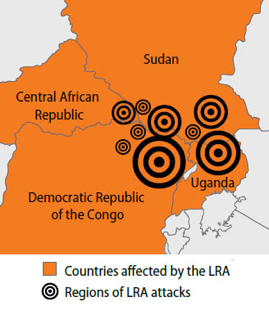
 |
Introduction/ History The Lord’s Resistance Army (LRA) is a rebel group centrally located in several African countries. The exact mission of the LRA is unclear, however the group formed due to turmoil between the Ugandan government in southern Uganda and the northern Ugandan tribe, the Acholi. The presidency of Yoweri Museveni took power of the government in 1986 when his army overthrew General Tito Okello from northern Uganda (Clark 2). Furthermore, the rebel group was influenced with western missionary involvement hence the emphasis on Christianity in the rebel group. The Holy Spirit Movement was the original name of the LRA and was led by a woman named Alice Lakwena. Lakwena had beliefs that the Holy Spirit would physically protect anyone with faith in the group and the lord. This started the revolt against the Ugandan government because anyone who did not follow or agree was killed. In the mid 1980’s Lakwena was exiled for her extreme beliefs. At that time Joseph Kony stepped into lead the rebel group to what it is now and it became the Lord’s Resistant Army.
The LRA’s Past Similar beliefs followed with the reformed rebel group. But there became a unique distinction. Kony revolted against the Ugandan government but he also revolted against the Acholi tribe, his own, for any non-believers. His first reported attack was in 1988 where many Acholi began to retreat to Southern Sudan for safety (Clark 2). There are many different theories of how Joseph Kony gained his power however his strategies were unmistakably successful. Abducting children, forming an army of child soldiers, and threatening everyone are his known skills. According to the article, The ICC ( International Criminal Court), Uganda and the LRA: Re-Framing the Debate, “Children have particularly suffered. It is estimated that they constitute over eighty – five percent of the LRA’s forces” (Clark 2). Assuming children are easily threatened is the only logical explanation as to why so many children make up the LRA. A child that is forced to kill or watch his/ her family die, pulled away from any educational future and that grows up knowing nothing but war will most likely be a faithful soldier to the only people he knows, the LRA. The children that escape, as strong as they are for escaping, end up with many troubles. There is traumatic psychological problems, malnourishment, physical injuries or amputees and many escape with no family to return to (Ehrenreich 81). The LRA has made a circle of destruction for so many generations of people in this region.
Where is the People’s Support? The Ugandan government set up protected camps near army bases for the safety of the people but in those camps there are problems as well. Thousands die due to lacking and inadequate health care, food, sanitation and the mass amount of people in these camps. The Ugandan government has not given up fighting but the LRA is constantly on the move depending upon where food and supplies are. There are 4 different countries that the LRA travels and fights in, Democratic Republic of Congo (DRC), Central African Republic (CAR), Sudan, Uganda, Burundi and Rwanda. These countries also form the Great Lakes Region. Due to the widespread region that the LRA is located in the Good Governance, Economic Development and Regional Integration Stability Pact was put in place by UN and AU in 2005 (Ettang 186). The DRC’s National and Regional Security Nexus article explains how the LRA and other rebel groups affect each of these countries. The DRC is prominent in the solutions to peace processes because of the amount of organizations, locally and internationally that contribute to the solutions and to the rebel groups. The regional connection between the differing countries is the abduction of children in one country and the recruitment training done over the border to another country. A perfect example is the northern Uganda region and the Southern Sudan region. Children are abducted from their villages in Uganda and then forced over the border into Sudan where they become recruits and sex slaves. In the 1990’s The Sudanese government aided in the LRA supplies and support. This was a conflict between the Sudanese government fighting the rebel group called John Garang’s Sudan People’s Liberation Army. It was either aid the LRA to overcome this rebel group or have the Sudan government be overthrown by both the rebel groups (Ehreneich 86). LRA’s supply source from Sudan has now ceased to exist and an article by Nancy Macdonald states, “Kony’s force has been reduced to fewer than 1,000 fighters and support staff – down from 5,000 in 2003 … access to Sudanese AK-47s dried up, have resorted to Paleolithic weaponry” (Macdonald 3) Conflicts with Progression to Peace
The ICC has been involved in the search for Kony since they announced his crimes against humanity in 2005 (Scott 2). The ICC has jurisdiction over 4 types of crimes, genocide, crimes against humanity, war crimes and crimes of aggression (Clark 143). The conflict within the LRA can also be a political situation because of the dictatorship presidency of Museveni. Therefore if the LRA is traced back to a Ugandan political turmoil, the ICC cannot indict him. Another conflict this rebel group creates is the fine line between justice and peace, and which comes first. The Good Governance, Economic Development and Regional Integration Stability Pact helps to enforce all aspects into one, because they are all connected. The challenge the Great Lakes Region faces is technological advances. The positive to this challenge is the international aid to these countries. One example in non-profit organizations using film as communicating these rebel wars. Kony 2012 The Invisible Children Inc. is a non-profit organization that produced a short film about the conflicts of the LRA focusing on Joseph Kony. The Invisible Children Inc. has its focus in Uganda beginning in 2005. They have incorporated their company with staff from the United States and in Uganda, along with thousands of volunteers all over the world. Kony 2012 brought to the world a man filled with corruption, facts of the LRA and emotional footage along with their own solution. There were many critiques to this film but the prominent few were, what this organization is truly promoting and why the facts do not add up with other sources. National Public Radio did a broadcast about the film and had a personal interview with Michael Wilkerson who wrote an article in Foreign Policy about the film as well. The main focus is on the Invisible Children’s film fact checking. What facts were included, what facts weren’t and what facts were not entirely factual were all points many viewers questioned. Donavan, staff member of NPR states “… and that’s what this film does is push a lot of buttons” (NPR transcript 2). Another critique that this film raised was the question of where is Africa’s voice in this film. The answer is in personal research. The film does not include any insight to how Uganda, Rwanda, DRC, CAR, and Burundi are dealing with their conflicts with rebel groups. The film finishes with only one message; “Let’s stop Kony now”. But who is the video referring to. Was there any information of how the Great Lakes Region is working with the UN and AU, no there was not. Even though the video did not include many important facts, it was a viewer friendly film. Unlike this report, the film touched every person that saw it. It made them feel what a report, covering facts, cannot. The film did do something extraordinary; it showed the world who Joseph Kony is. It is clear these African countries still need aid from the international community. The decision to provide that support lies in our hands. |
